
 Cluchr Aero System
You don't hold stock, you broker it. Cluchr Aero System connects the whole RFQ-to-invoice chain, so the only thing slowing down your next deal is your supplier's price, .
$42 per user per month · every feature included · 2-user minimum
Open Deals
14
Accepted (mo.)
$128.4k
RFQ #RQ-0081432: 3 offers
From RFQ to invoice, step by step.
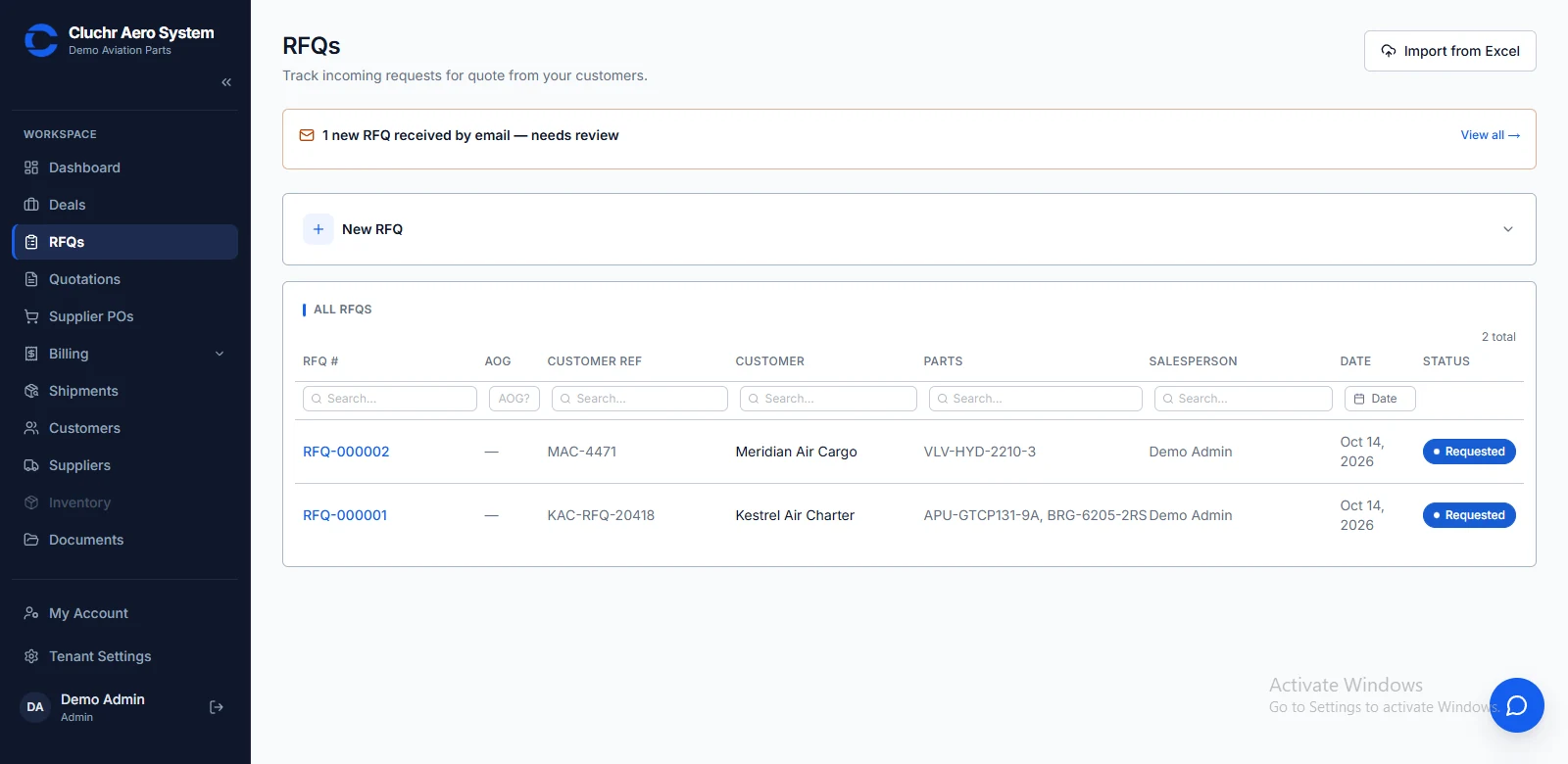
Step 1 of 9
Set up forwarding once, and every customer RFQ email is sent to the system automatically. Nobody copies part numbers into a spreadsheet.
You're not losing deals on price. You're losing them on paperwork.
QUOTATION
To whom it may concern,
Part: APU-GTCP131-9A .......... Qty 1
Part BRG-6205-2RS, qty=12
Total: ~$46,170?
A sloppy-looking quote is a lost deal
Every quote gets typed up fresh in Word or copied from whatever file's still open, mismatched fonts, no logo, formatting that shifts from one document to the next. Customers judge how professional you are by the first document you send them, and a sloppy one makes them wonder what else you're cutting corners on.
One deal. One thread. Zero re-typing.
One connected dealEvery RFQ, quote, order, and invoice for one deal, all in one screen, not seven files.
Everything a dropshipping desk actually needs, nothing it doesn't
Every document lives under one deal
Open a deal and see its whole history: every RFQ, quote, supplier PO, invoice, and shipment tied to it, in one chronological timeline. No hunting across five different files to piece together what a part you never touched is actually doing.
Answer a customer the same hour, not the next day
Turning three supplier offers into a clean customer quote in Excel means retyping every part number and price into a fresh template. That's the difference between quoting back today and tomorrow. Here, the same quote is ready before you've finished comparing offers.
The things people ask before they switch.
$42 per user per month. Every feature is included, and there are no tiers to choose between. The minimum is 2 users.
Yes. Your data is yours. Ask us at any time and we'll send you a complete export of your records. A self-serve export button is coming.
Yes. Upload an Excel sheet and the system suggests how the columns map, shows you a preview, and only saves once you confirm. You can also add suppliers and customers one at a time by hand. RFQs can be imported from Excel too.
Yes. Forward a customer's RFQ email to your company's private address and it arrives as a draft RFQ, matched to the right customer by the sender's email. You review it and confirm. PDFs attached to the email are read too.
Jumping between five spreadsheets is its own full-time job
The RFQ lives in one file, the supplier tracker in another, and the quote draft in a third. Comparing three offers means constantly switching tabs and copy-pasting numbers between windows. That's time spent hunting for data instead of closing the deal.
A retyped PO number is a mistake your supplier ships on
Every manual re-entry between your quote, your Supplier PO, and your invoice is a chance for a number to quietly change. And unlike a warehouse, there's no shelf to double-check against before your supplier ships straight to your customer.
A hand-typed invoice is time you don't get back
Copying every line item into a new invoice and adding up the total by hand doesn't take long once. It takes long every single time. Multiply that by every invoice you send this month, and it's hours spent on data entry instead of the next deal.
Step 1
RFQ
Every competing supplier offer, side by side. When sourcing is the whole business, the best price can't stay buried in a reply-all.
Step 2
Quotation
Built straight from the supplier offer you actually picked, so the number your customer sees always matches the number you were quoted.
Step 3
Supplier PO
One click from quote to order. It's the exact instruction your supplier ships against, numbered once and impossible to duplicate.
All the structure of an ERP, none of the ERP
Most platforms built for aviation parts trading are priced and built for airlines and MROs: six-figure contracts, a months-long rollout, a dedicated administrator just to run it. This one is built for small-to-medium companies that don't hold inventory. It's easy to use, requires no heavy training, and it's ready the same day you sign up.
Your branding, on autopilot
Upload your logo and pick your color once in Settings. Every quote, PO, and invoice looks like it came from an established shop, even though the part itself ships straight from your supplier and never through your address. It's a real PDF, generated automatically the moment you create the document. Nothing to format by hand in Word.
Every RFQ, captured automatically
Every RFQ that comes in by email is read automatically the moment it arrives, matched to the right customer, and staged as a draft ready to confirm with one click. Nobody retypes a customer's email into a form by hand.
Your company's data, walled off by the database itself
Every tenant's RFQs, suppliers, and pricing are isolated at the database layer, not just hidden by the app's screens. Your supplier list and their prices are your edge, and they're never reachable from another company's login.
Traceability on every invoice line
Record the serial number, who tagged the part, the tag date and type, and its traceability once, and they print straight onto the invoice. Your supplier ships the part, but your customer still gets the paper trail they ask for.
Bring what you already have
Your customers, suppliers, and RFQ sheets are already in Excel. Upload them, check the preview, and they're in. You can also add records by hand. Nothing gets re-keyed from scratch, and nothing is committed until you've looked at it.
Built for a team, not just one desk
Give each salesperson their own login. Everyone in the company can see every deal, but only the person who opened a deal can change it. Admins manage the team, the company settings, and can see who has signed in.
Yes. Each person gets their own login with an Admin or Sales role. Everyone in the company can see every deal, and only the person who opened a deal can edit it. Pricing is per user, with a minimum of 2.
Each company's data is separated inside the database itself, so another company's login can never reach your RFQs, suppliers, or prices, even by mistake. Traffic is encrypted, and passwords are never stored in readable form. Inside your company, Sales users can't delete records or edit supplier bank details, and sign-ins end when the browser closes. We don't sell your data.
Only two things. The text and PDFs of RFQ emails you choose to forward are read by an AI model to pull out the requested parts, and the questions typed into the in-app help chat are answered by one. Everything it extracts is shown to you for confirmation before it becomes a record. Your quotes, prices, suppliers, and invoices are not sent to it.
Setup takes less than 24 hours. We create your company and your first login, you upload your customers and suppliers from Excel, and you can start your first deal.
Step 4
Proforma / Invoice
Bill with confidence. Traceability fields fill in as the part clears customs, not after, even though it never touches your warehouse.
Step 5
Shipment
Track it from your supplier's dock to your customer's door. You never touch the part, but you never lose sight of it either.